
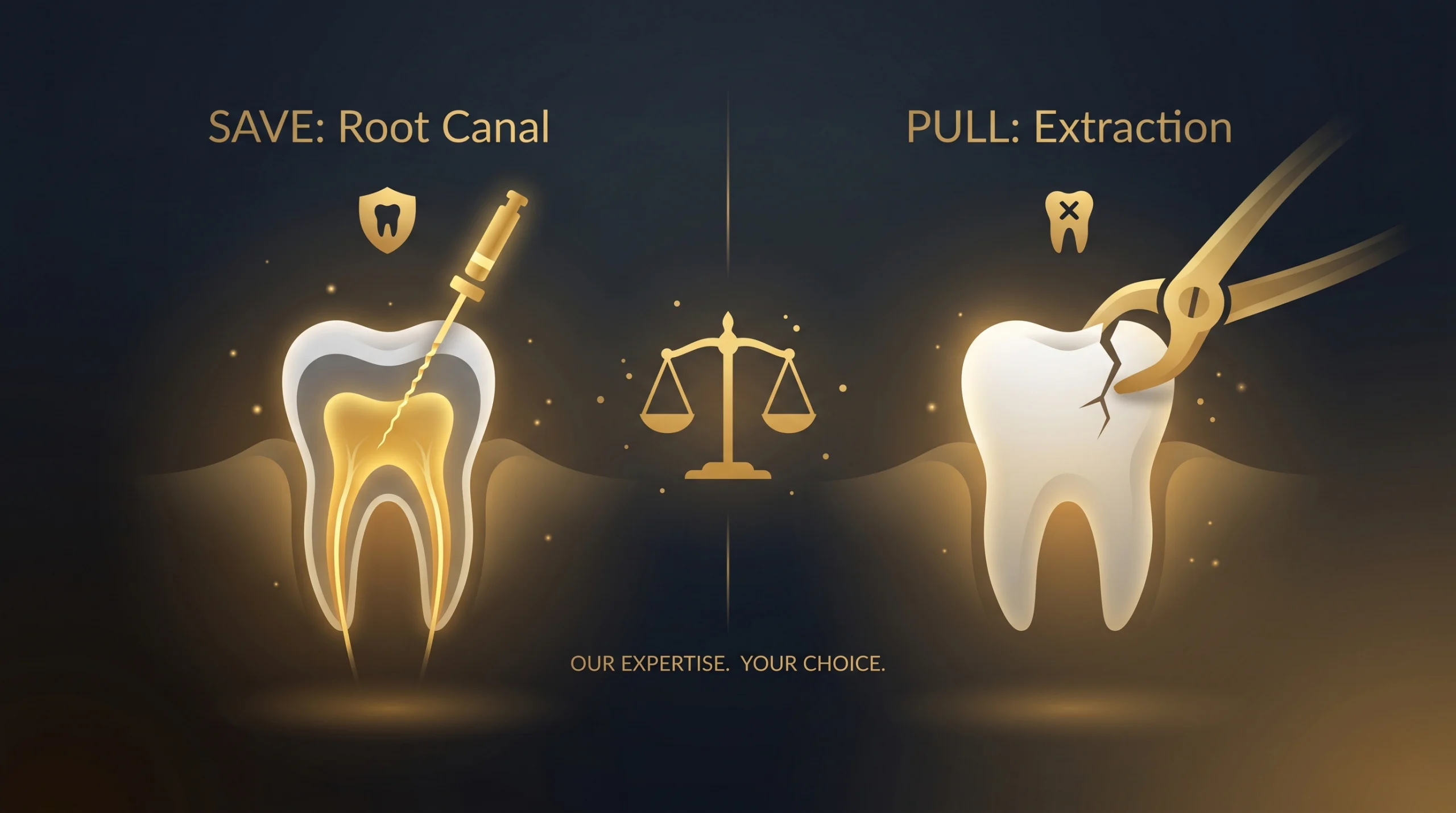
Save It or Pull It? Root Canals vs. Tooth Extractions Explained
23 April 2026
Clinically reviewed by Dr Shaheen Alghofari, GDC-registered dentist (GDC no. 318372) at Twilight Dental, Leeds. Need to be seen today? See our root canal treatment in Leeds — consultation £24 until 10pm, or call 0113 819 7865.
Quick answer: Root canal treatment saves your natural tooth by removing the infected nerve, cleaning the canals and sealing them, and is usually the better long-term choice if the tooth can be restored. Extraction is quicker and cheaper at first but leaves a gap that may later need an implant, bridge or denture. The right option depends on how much healthy tooth is left.
When you are suffering from a severe, throbbing toothache, you only want one thing: for the pain to stop immediately. For many patients, the quickest solution seems to be simply pulling the tooth out. But is that always the best choice?
At Twilight Dental in Leeds, one of the most common questions our emergency patients ask is: “Should I save this tooth with a root canal, or just have it extracted?” As dental professionals, our goal is to get you out of pain while protecting your long-term oral health. Here is our expert guide on how we determine whether a tooth can be saved or if it needs to be removed.
When Can We Save the Tooth? (Root Canal Treatment)
Whenever possible, saving your natural tooth is always the preferred option. Nothing looks, feels, or functions quite like a natural tooth.
A Root Canal Treatment is recommended when the inner nerve of the tooth is infected or inflamed (usually due to deep decay or a crack), but the outer structure of the tooth is still relatively strong and intact.
Why choose a Root Canal?
- Instant Pain Relief: During Stage 1 of the treatment, we remove the infected nerve. Once the nerve is gone, the severe pain disappears.
- Preserves Your Smile: You get to keep your natural tooth, meaning there are no visible gaps in your smile.
- Prevents Future Problems: Keeping the tooth prevents neighbouring teeth from shifting out of place and maintains your jawbone structure.
The Process: We offer both Stage 1 Root Canal (Pain Relief) to stop the emergency immediately, and the Completion of the Root Canal to permanently seal and protect the hollowed tooth so it lasts for years to come.
When Must the Tooth Be Pulled? (Tooth Extraction)
While modern dentistry can save many teeth, there are situations where a tooth is simply “too far gone” and extracting it is the safest, healthiest option.
We will recommend a Tooth Extraction if:
- Severe Damage: The tooth is fractured down the middle or broken below the gum line, making it impossible to restore with a filling or crown.
- Advanced Gum Disease: The bone supporting the tooth has deteriorated significantly, making the tooth extremely loose.
- Impacted Wisdom Teeth: A wisdom tooth is growing at a painful angle, causing recurrent infections (Pericoronitis) and damaging surrounding teeth.
- Massive Infection: A severe dental abscess has compromised the surrounding bone and tissue, and a root canal cannot clear the infection.
The Process: Depending on the tooth’s condition, we perform both Simple Extractions for easily accessible teeth and Surgical Extractions for complex cases, such as impacted wisdom teeth or severely broken roots. Both procedures are carried out under profound local anaesthetic, ensuring you feel no pain during the removal.
The “Just Pull It” Myth: Why Cheaper Now Can Mean More Expensive Later
Many patients request an extraction because it is generally quicker and has a lower initial cost than a root canal. However, pulling a tooth that could be saved often leads to more complicated and expensive problems down the road.
When you lose a tooth:
- Your chewing function is impaired.
- The surrounding bone begins to shrink.
- Adjacent teeth naturally drift into the empty space, altering your bite.
Replacing an extracted tooth later with a dental implant or a bridge is significantly more expensive and time-consuming than completing a root canal today.
The Final Verdict: Let the Experts Decide
You do not have to make this decision alone, and you certainly should not make it while you are in agonizing pain.
The only way to definitively know if your tooth should be saved or pulled is through a professional clinical assessment and an X-ray. At Twilight Dental, we will thoroughly examine your tooth, explain your options clearly, and help you make the best decision for your health and your budget.
Are you in pain right now? Whether you need a fast root canal to save your tooth or a gentle extraction to remove the problem, we are here to help.
Book an Emergency Assessment at Twilight Dental in Leeds today, or call our team for same-day relief.
📩 receptiontwilight@outlook.com
Frequently asked questions
Is it better to have a root canal or an extraction?
If the tooth has enough healthy structure and the gum and bone around it are sound, keeping it with root canal treatment is usually better for chewing and for the neighbouring teeth. If it is badly broken or cracked into the root, extraction may be the sensible choice.
Is root canal treatment painful?
The treatment is carried out under local anaesthetic and should feel similar to having a filling. It is designed to remove the source of pain, so most people feel much better afterwards, with some tenderness for a few days.
What happens if I leave an infected tooth untreated?
The infection can form an abscess, spread into the jaw or face and destroy more of the tooth, making it harder to save. Painkillers and antibiotics alone will not cure it.
Can I get a second opinion on root canal versus extraction in Leeds?
Yes. A £24 consultation at Twilight Dental includes examination and X-rays, and we will explain both options with costs in writing so you can decide.
Not sure whether to save or remove a tooth?
We will examine the tooth, take X-rays and talk you through both options honestly, 24 hours a day, from a £24 consultation.
Treatment pages related to this article
In pain now? Reception is answered 24 hours a day — call 0113 819 7865 or book online.
Tags: Leeds,root canal treatment