
Tooth Extraction Explained: Simple vs. Surgical Extractions and What to Expect
3 June 2026
Clinically reviewed by Dr Shaheen Alghofari, GDC-registered dentist (GDC no. 318372) at Twilight Dental, Leeds. Need to be seen today? See our tooth extraction in Leeds — consultation £24 until 10pm, or call 0113 819 7865.
Quick answer: A simple extraction removes a tooth that is fully visible in the mouth, loosening it with instruments under local anaesthetic. A surgical extraction is needed when a tooth is broken at the gum line, has curved roots or is impacted, such as many wisdom teeth, and involves a small cut in the gum and sometimes removing bone. Both are done with the area fully numbed.
Hearing that you need to have a tooth pulled can instantly trigger anxiety for many patients. Thoughts of pain, complex procedures, and long recovery times often come to mind.
However, modern dentistry has evolved significantly. At Twilight Dental in Leeds, tooth extractions are routine, safe, and most importantly, highly comfortable procedures.
If our emergency assessment determines that your tooth cannot be saved and must be removed, your dentist will recommend either a Simple Extraction or a Surgical Extraction. But what exactly do these terms mean, and what should you expect in the dental chair? Here is a straightforward guide to put your mind at ease.
What is a Simple Extraction?
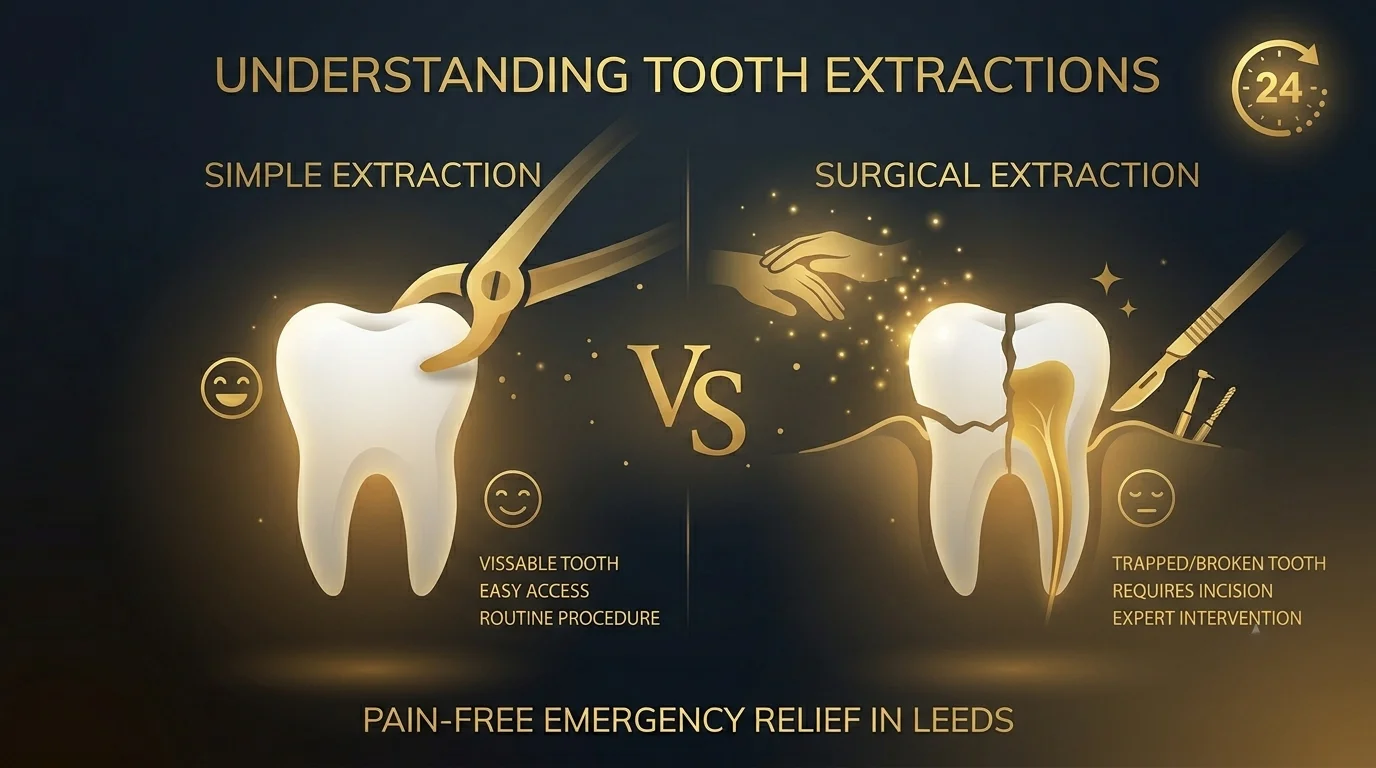
A simple extraction is exactly what it sounds like—a straightforward removal of a tooth.
When is it used? This procedure is performed on teeth that are fully visible above the gum line and have relatively straight roots. It is commonly used for teeth suffering from severe decay, advanced gum disease, or crowding.
How does it work?
-
Numbing: The area is completely numbed using a local anaesthetic.
-
Loosening: The dentist uses an instrument called an elevator to gently wiggle the tooth and loosen it from the surrounding bone and ligaments.
-
Removal: Once loose, a pair of dental forceps is used to carefully grasp and remove the tooth in one piece.
The entire process is usually over in a matter of minutes.
What is a Surgical Extraction?
The word “surgical” can sound intimidating, but it simply means the dentist needs to take a few extra steps to access the tooth safely.
When is it used? A surgical extraction is required when a tooth is not easily accessible. This happens if the tooth is:
-
Broken off at the gum line.
-
An impacted wisdom tooth that has not fully erupted.
-
Featuring highly curved or complex roots that are anchored tightly in the bone.
How does it work?
-
Numbing: Just like the simple extraction, the area is deeply numbed. You will not feel any pain.
-
Accessing the Tooth: The dentist will make a small, precise incision in the gum tissue to reveal the hidden tooth and bone.
-
Sectioning (if necessary): In some cases, to make removal easier and protect your jawbone, the tooth is divided into smaller pieces and removed section by section.
-
Closing: The gum is closed with a few self-dissolving stitches to ensure fast, clean healing.
What to Expect: Will It Hurt?
This is the number one question we get asked, and the answer is no.
Whether you are having a simple or surgical extraction, you will be given a highly effective local anaesthetic. This means the nerves in that area are completely “asleep.”
During the procedure, you will feel pressure and movement, but you will not feel any sharp pain. If at any point you feel uncomfortable, you simply raise your hand, and the dentist will stop and administer more anaesthetic. You are always in control.
Post-Procedure Recovery
After your extraction, we will provide you with a sterile gauze pad to bite down on to help a protective blood clot form. Healing is usually very fast. By following our simple 24-hour aftercare instructions—like sticking to soft foods and avoiding smoking or using straws—you will be back to normal in no time.
Need a Tooth Extracted in Leeds?
Do not let fear keep you in pain. An infected or broken tooth will only worsen over time, leading to more complex issues.
At Twilight Dental, we pride ourselves on providing gentle, judgment-free emergency care for nervous patients. If you suspect you need a tooth pulled, Book an Emergency Consultation with us today. We will assess the tooth, explain your options, and get you out of pain safely.
📩 receptiontwilight@outlook.com
Frequently asked questions
How do I know if I need a simple or surgical extraction?
The dentist decides after examining the tooth and taking an X-ray. Broken-down teeth, teeth with curved or long roots and impacted wisdom teeth are more likely to need a surgical approach. You will be told which applies before treatment starts.
Does a tooth extraction hurt?
You should feel pressure but not sharp pain, because the area is numbed with local anaesthetic first. Some soreness afterwards is normal for a few days and is usually controlled with paracetamol or ibuprofen.
How long does it take to recover from an extraction?
Most people feel back to normal within two to three days after a simple extraction and within about a week after a surgical one. Avoid smoking, spitting and hot drinks for the first 24 hours to protect the blood clot.
Can I have a tooth taken out the same day in Leeds?
Often, yes. At Twilight Dental the £24 consultation includes examination and X-rays, and if extraction is the right treatment it can usually be done at the same appointment, day or night.
Need a tooth out?
We assess the tooth, explain whether it is a simple or surgical extraction and give you the cost in writing, 24 hours a day, from a £24 consultation.
Treatment pages related to this article
In pain now? Reception is answered 24 hours a day — call 0113 819 7865 or book online.